



You start on the north side of the Geisenheim station. At first, walk 200 meters on "Bahnstraße" to the right to "Talstraße", then turn left up "Klausstraße" and continue upwards to the bus stop at the high-rise buildings. From there, "Langestraße" leads briefly steeply upward and past the edge of town (transformer station) to the road from Geisenheim to Marienthal.
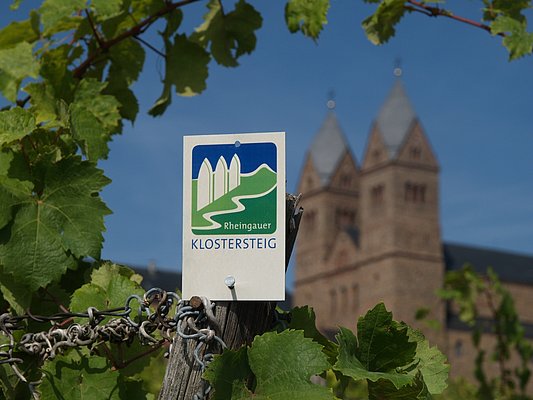
From nearby "Fladeneck" (a bench at a fenced water reservoir), follow the paved service road through the vineyards toward Schloss Johannisberg. Directly at the town edge, turn left at the height of the "Hohlweg" and stroll past a small chapel with a beautiful view of Schloss Hansenberg. Shortly afterward, turn left onto the Monastery Trail.
On the following stretch to Marienthal Monastery lie several mills in the Elsterbach valley, where grain was once ground, oil was pressed, and stones were ground: Weihermühle, Ostermühle, Reuß's Mill, and Grinding Mill. After crossing the creek, the Monastery Trail merges onto the road from Johannisberg to Marienthal Monastery.
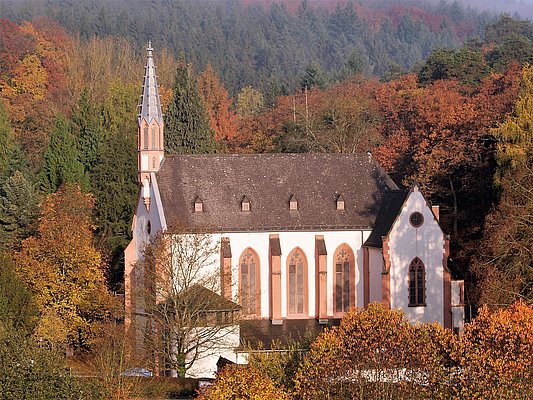
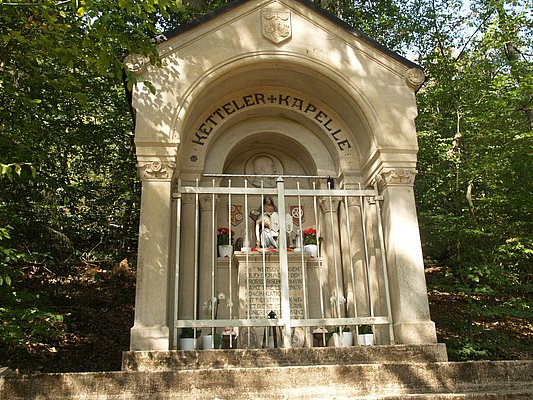
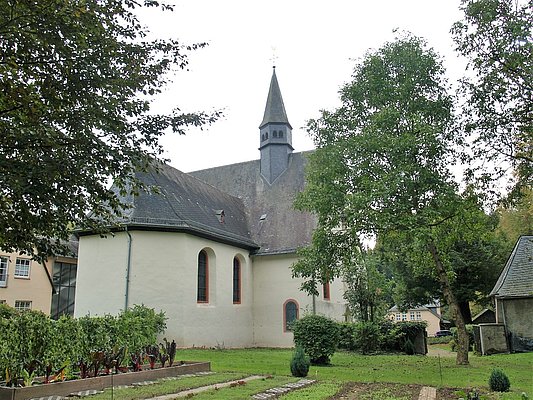
From the portal of the monastery church, follow the markings past the pilgrim hall (toilets) onto the cloister in the meadow valley. About 100 meters further, the Monastery Trail turns left and leads steeply up the slope to the Ketteler Chapel. It stands at the favorite place of Wilhelm Emmanuel von Ketteler (1811-1877), who became known in church history from 1850 as the Mainz "workers' bishop".
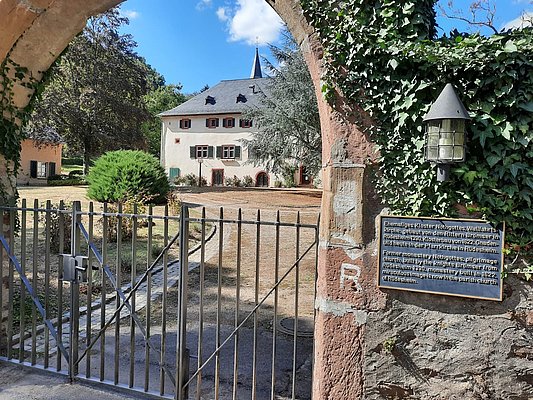
After a short break, turn left into the forest and soon arrive at the northern edge of the new development area of Marienthal. It is now not far to the hiking parking lot "Brünnchen" on the state road from Geisenheim to the Rüdesheim district of Presberg. 300 meters further, an open circular pavilion at Offermann Pond invites you to the next rest. From here, the Monastery Trail follows the Blaubach to Nothgottes Monastery, which lies hidden in the idyllic valley. The ensemble, where since 2013 ten Cistercian monks from the Vietnamese Abbey Chau Son have been revitalizing the order's tradition, goes back to a legend. A farmer is said to have found the figure of the Savior while plowing the field and simultaneously heard the call "Noth Gottes" (Need of God). Subsequently, the Rüdesheim knight Johann Brömser erected a chapel in the quiet valley.
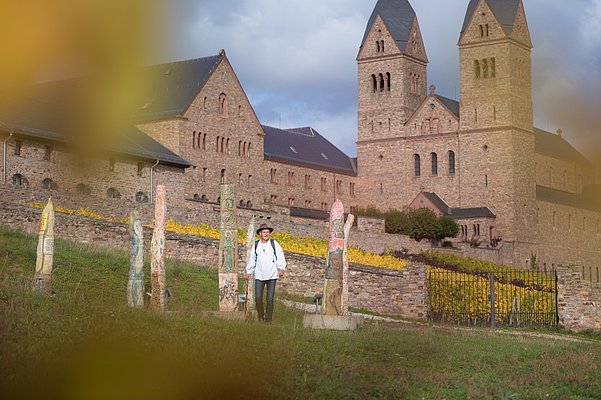
To St. Hildegard Monastery, the Rheinsteig and Monastery Trail now share the same route. Initially, it leads downhill in the Blaubach valley to the junction at "Brückelchen", where the markings direct right to the "Leideck" junction. Here, the Monastery Trail returns to the vineyards. Passing the shooting house, it goes to a resting place where the two towers of St. Hildegard Abbey first come into view. The two benches near the tree group invite a short rest with a wonderful view over the Rheinhessen hilly land and to the broad ridge of the Donnersberg (Palatinate).
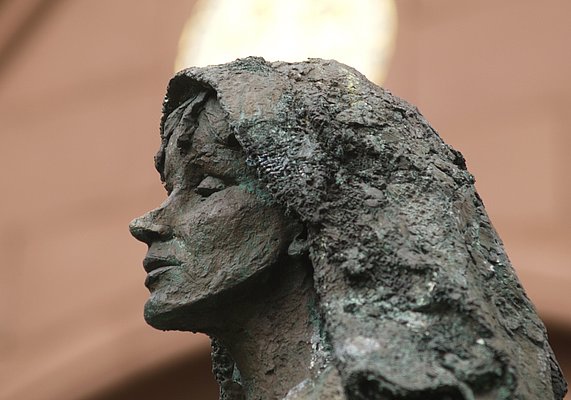
Then the ascent to the abbey can be made easily in one stretch. The convent of Benedictine nuns is one of the most lively monastic communities in Europe. Abbess Dorothea is the 40th successor of Hildegard of Bingen. Around 1150, Hildegard founded a convent for women on the Rupertsberg in today’s Bingerbrück. When this monastery became too small for all novices, Hildegard took over a discontinued Augustinian priory in Eibingen in 1165 and founded her second monastery there. Following the two monasteries (Rupertsberg was destroyed in the Thirty Years’ War, Eibingen was dissolved in 1802), the abbey was newly established in the vineyards in 1904. Today, 45 Benedictine nuns live there; they run, among other things, a monastery shop, a monastery café, a goldsmith, and a ceramics workshop as well as the world’s only monastery winery, which is run by a woman known as "winemaker sister" Thekla.
After quiet internal contemplation in the abbey and refreshment at the monastery café, you descend on the Hildegard Way to Eibingen to the golden shrine in the parish church. Now it’s time to say goodbye to Hildegard, who was formally canonized only in 2012. Along "Marienthaler Straße" and through the vineyards, you hike to the outskirts of Geisenheim, where you join a Rheinsteig access path.
The white R on yellow background leads you back to the station. While waiting for the train, the day runs through your memory once again – nowhere in Germany are there so many living monasteries with inner contemplation at such a short distance.
Parking spaces are available at Geisenheim station.
Access via Rheingau line / Vias Frankfurt - Wiesbaden - Koblenz
Rheingau-Taunus Culture and Tourism GmbH
Tel.: 06723-60272-0

WIESBADEN RHEINGAU
·
:
Wolfgang Blum


