



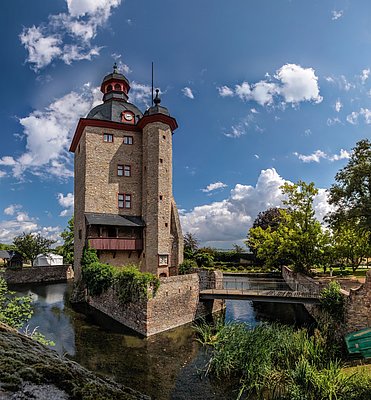
You start at the Oestrich-Winkel train station in the district of Mittelheim. The "yellow R" of the access path to the Rheinsteig leads you along Rheingaustraße to the railway underpass. Then you follow Rieslingstraße out of the town and hike through the vineyards to the rest pavilion on Honigberg, where you meet the "blue R" of the Rheinsteig. From there, it’s just a short hop to the left across Friesenthal to Schloss Vollrads.
For centuries, the von Greiffenclau family resided here. Originally, they lived in the Gray House on the Winkel Rhine bank, the oldest habitable stone house in Germany. When it became too small for the counts, they built a residential tower in the vineyards around 1330 – which still stands today. In the 17th century, the Cavalier House and manor house were added. Subsequently, Vollrads developed into one of the most renowned family wineries in Europe. It likely would have remained so if Erwein Count Matuschka-Greiffenclau had not committed suicide on the nearby vineyard hill in August 1997. Thus, he went down in history as the last Greiffenclau at Schloss Vollrads. The winery still plays an important role among the VDP winemakers today.
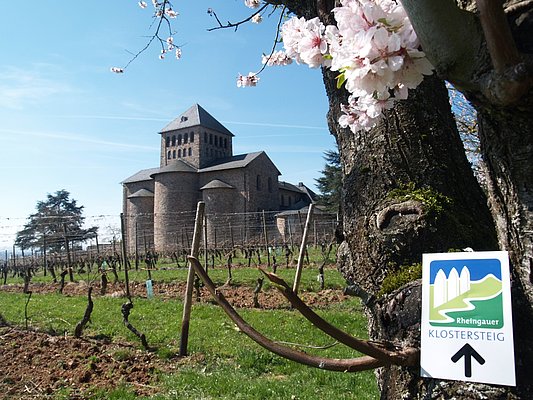
You stroll through the castle courtyard to the rear gate, cross the parking lot, and enter the so-called Vollradser Wäldchen at the forest edge. Further up, the path merges at a forest corner onto an asphalted service road. Follow this slightly uphill to the right and pass the dog training ground toward Pfingstbachwiesen to the signpost "Kornsmühle." Here, you meet the Rheingau Monastery Trail. From here, it is 5.1 kilometers to Schloss Johannisberg.
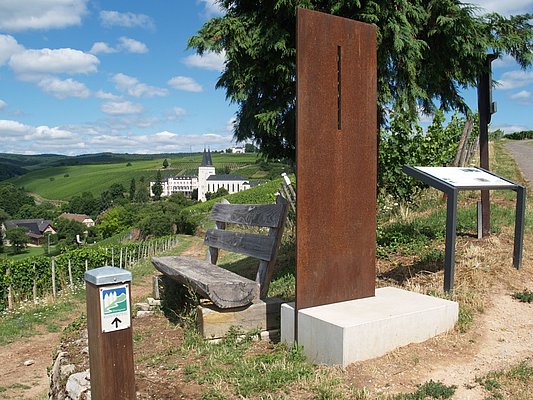
Initially, the trail goes straight and steeply uphill in the forest to the junction "Hohe Eichen." The route then turns sharply left onto a forest path that gently winds downhill in the "Kohlrech" area. About a kilometer after this turnoff, the monastery trail meets a crossing forest road. Turning left here leads you into the vineyards. Now it’s only a few meters downhill to Rest Point III on Honigberg. A bench invites you to rest; the text of a Peruvian church song written on a plaque encourages inner reflection. This spiritual impulse invites you to recognize the Lord – in the flowers, the vines, the river, and the people you encounter on the Rheingau Monastery Trail.
After a short stop, continue downhill toward the Rhine valley. At Sterzelpfad (signpost "Dachsberg"), the monastery trail crosses the Rheinsteig. About 200 meters further toward the Rhine valley, the route turns right at a marking post in the vineyards. Attention is required here: in the section up to the Ansbachgraben, the trail changes direction several times within the vineyards. Beyond the hollow, the markings lead to the road from Winkel to Johannisberg, which is crossed about 200 meters further south. Before you stands the imposing Johannisberg Basilica rising from the vineyards. Just before reaching it, a break at Goetheblick is worthwhile.
From this viewpoint, the Rheingau with the widest point of the river presents itself so magnificently that Goethe called it "blessed stretches." No one has contradicted him to this day. One could end the hike enjoyably on the resting bench under the tree. But you want to continue. The basilica stands atop the hill where Benedictines founded the first monastery of the Rheingau around 1100. After stamping your pilgrim’s passport in the church, follow the signs past the castle back into the vineyards. At the info pillar with a view of Abbey St. Hildegard, the monastery trail veers half-right toward Hotel Schloss Johannisberg. Turn left, stroll down the vineyard hill to Märzackerweg, and continue from the nearby small chapel toward the Rhine. A few meters past the bridge next to a ford, you reach the former Klause monastery and the mill hiking trail in the Elsterbach valley.
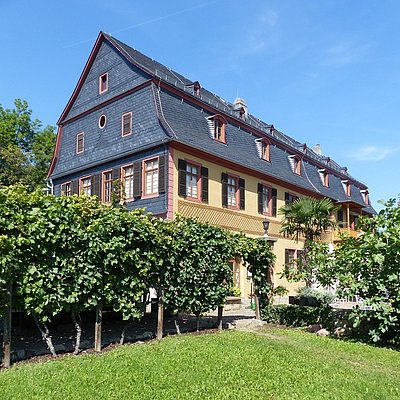
Follow it to the left to Ankermühle, then past the junction to Weißmühle to Krayersmühle. From there, it’s not far under the railway embankment to the main road in Winkel, where you turn left and walk to Lindenplatz. Here stands the Brentanohaus, the summer residence of the Frankfurt merchant family of the same name. It is considered one of the intellectual and cultural centers of the Rhine Romanticism. Guests included the Brothers Grimm and Goethe. The room Goethe stayed in during his 1814 visit can be viewed by appointment. If you wish, you can now take the bus to the train station. It is nicer to walk to the Rhine and stroll upstream along the towpath to the wine tasting stand at the ferry to Freiweinheim. After a pleasant "nightcap," it’s a short five-minute walk to the train station from there.
As an alternative to some parking spaces at the train station, sufficient parking is available at the Basilica parking lot.
Access via Rheingau line / Vias Frankfurt - Wiesbaden - Koblenz
Oestrich-Winkel / Mittelheim train station

WIESBADEN RHEINGAU
·
:
Wolfgang Blum